
By Daniel Obahor, GPhC-registered pharmacist and founder of CardivaRx Ltd. This article draws on UK formulary analysis, OpenPrescribing data, NICE Technology Appraisals, and Drug Tariff documentation to examine why patient access to modern cardio-metabolic treatments varies dramatically across England. Written during the pre-launch phase of CardivaRx, a private cardio-metabolic prescribing service planned for 2027 following completion of Independent Prescriber qualification.
What Does “Formulary” Actually Mean?
Most patients hear the word “formulary” in a clinical setting and assume it’s medical jargon they can ignore. It isn’t. It’s the single most important word for understanding why some UK patients access certain treatments, and others don’t.
A formulary is, in plain terms, a list. Specifically, it’s a list of medications that a particular healthcare organisation has agreed to fund and prescribe, usually with specific rules about who can prescribe what, under what circumstances. Different organisations maintain different formularies:
- Hospital trusts maintain hospital formularies governing what medications you can be prescribed during a hospital stay
- ICBs (Integrated Care Boards) maintain regional formularies for primary care prescribing in your area
- Individual GP practices may have additional prescribing preferences within their ICB’s framework
- Private prescribers (including services like CardivaRx) work to NICE clinical guidelines rather than restricted local formularies
How Formulary Tiers Work
Most UK ICB formularies classify medications using a “traffic light” system. The most common version looks broadly like this:
- GREEN — Suitable for initiation and ongoing prescribing in primary care. Your GP can prescribe these directly.
- AMBER — Specialist involvement required. Some formularies split this into multiple sub-tiers (Amber 1, 2, 3) depending on whether specialist input is needed for initiation only, ongoing monitoring, or full shared care.
- RED: Specialist or hospital prescribing only. Even if you meet clinical criteria, your GP cannot start or continue these medications without specialist oversight.
- Non-Formulary / Not Approved: The medication is either not actively recommended for routine use in your area or has not yet been formally reviewed.
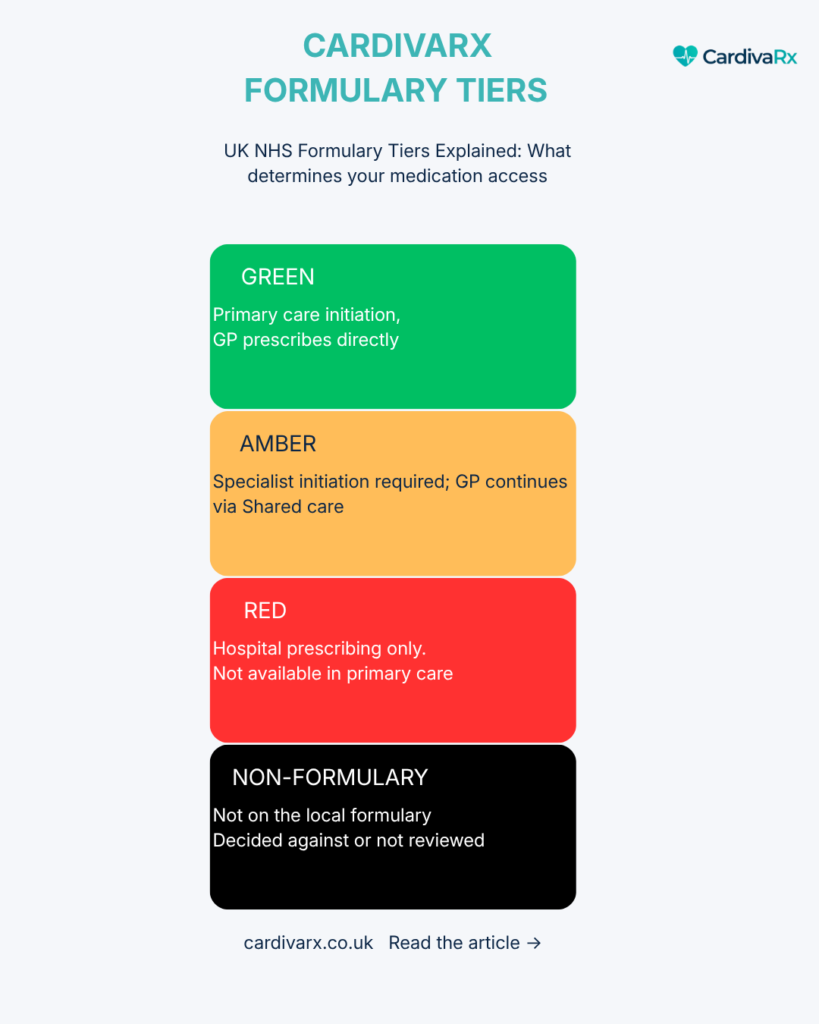
But here’s an important nuance: the classification system itself varies between ICBs. Some ICBs use a six-tier system with “On Formulary Preferred,” “On Formulary Second Line,” and “On Formulary Third Line” alongside specialist categories. Others use a more granular eight-tier system including three sub-types of “amber” specialist arrangements. A patient moving from one area to another may encounter completely different formulary vocabulary for the same medications.
How Formulary Decisions Get Made
Formularies aren’t arbitrary lists. Each ICB has a formulary committee (sometimes called a Medicines Optimisation Committee or Area Prescribing Committee) that evaluates new medications and reviews existing ones. These committees typically include clinicians (consultants, GPs, specialist nurses), pharmacists, and commissioning representatives.
When evaluating whether to add a medication to the formulary, committees assess three core pillars:
1. Clinical evidence
How strong is the evidence that the medication works? Committees review NICE Technology Appraisals, randomised controlled trials, real-world evidence, and clinical guidelines. They consider not just whether a medication works, but whether it works better than existing alternatives in the formulary.
2. Cost-effectiveness and affordability
Even when a medication clearly works, the question is whether the clinical benefit justifies the cost. NICE makes national cost-effectiveness assessments using a threshold of £25,000-£35,000 per Quality-Adjusted Life Year (raised from £20,000-£30,000 in April 2026, the first change since NICE’s establishment in 1999). But ICBs also consider local affordability: how much would adding this medication to the formulary cost their fixed annual budget? For high-cost medications, this can mean genuine trade-offs in resources relative to other clinical priorities.
The threshold update wasn’t an isolated decision. In December 2025, the UK government announced a trade agreement with the United States covering pharmaceutical pricing. In exchange for a preferential 0% tariff on UK pharmaceutical exports to the US, the UK government agreed to increase NHS spending on medicines, including raising the NICE cost-effectiveness threshold and reducing the VPAG repayment rate (the proportion of branded medicine revenue that drug companies return to the NHS). These changes are projected to increase NHS medicine spending by between £3 and £6 billion over the coming years. For patients, this matters because the international trade context now directly shapes which medications receive NICE approval and at what cost-effectiveness threshold.
3. Safety
What are the side effect profiles? Monitoring requirements? Risk management implications? Some medications are clinically effective but require an intensive monitoring infrastructure that’s only available in practice in secondary care.
Committees balance these three pillars to produce equitable, evidence-based prescribing decisions across the local health economy. The outcomes are usually rational responses to genuine constraints. But the same three pillars can produce different conclusions in different areas, which is part of why prescribing patterns vary so dramatically across England.
What “Not On The Formulary” Actually Means
When your GP says “that medication isn’t on our formulary,” they usually mean one of four things:
- It’s classified as red or specialist-only. It exists, but only secondary care can initiate or continue it.
- It’s classified as non-formulary. Your ICB has actively decided not to fund it for routine use, or hasn’t reviewed it yet.
- A clinically equivalent alternative is preferred. This is one of the most common reasons. The medication may work, but the formulary already includes another medication in the same class that’s clinically equivalent and more cost-effective for the NHS. For example, when two statins offer comparable LDL reduction but one is significantly cheaper, the cheaper option becomes the formulary-preferred choice. This isn’t an arbitrary restriction; it’s resource stewardship.
- It’s restricted to specific indications. The formulary allows it, but only for particular patient groups, severe cases, treatment failures, or specific clinical thresholds.
What this does NOT mean:
- The medication doesn’t exist or isn’t available anywhere
- You don’t medically need it
- It’s automatically dangerous or unsuitable for you
- You can’t access it through other routes
- You’re being denied better care
What Patients Can Do
When you hear “not on the formulary,” informed questions you can ask include:
- What tier is this medication on your local formulary?
- Is this an “amber” or “red” classification, and what would that involve in terms of specialist referral?
- Is there a clinically equivalent alternative on the formulary that I could try?
- Could specialist referral lead to access through shared care?
- Where is this medication routinely prescribed, and what’s different there?
For most patients, formulary positioning is invisible. You receive your prescription and don’t see the structural decisions behind it. But when treatment options are limited or unfamiliar, understanding how formularies work and that different ICBs use different classification systems can transform a confusing situation into one you can actually navigate.
The Drug Tariff: Another Layer Patients Should Know About
Beyond formularies, there’s another invisible layer that shapes patient access to medications: the Drug Tariff.
According to Community Pharmacy England, the Drug Tariff “provides information on what will be paid to pharmacy owners for providing NHS Services. This encompasses both reimbursement (i.e. the cost of drugs and appliances supplied against an NHS prescription) and remuneration (i.e. professional fees/allowances which are paid as part of the NHS pharmacy contract).”
In plain terms: the Drug Tariff covers two things:
- Reimbursement: what the NHS pays the pharmacy for the actual medication dispensed
- Remuneration: what the NHS pays the pharmacy for the professional service of dispensing (the dispensing fee and related allowances)
Published monthly by the NHS Business Services Authority, the Drug Tariff runs to over 1,200 pages of pricing data, category classifications, professional fee schedules, and prescribing rules. Wales, Scotland, and Northern Ireland have similar but separate systems.
For most patients, the Drug Tariff operates invisibly. You pay £9.90 per prescription item in England, or receive your medication free if you’re exempt, and don’t see the financial machinery determining how your pharmacy gets paid. But when problems arise supply shortages, branded-versus-generic disputes, unexpected medication changes the Drug Tariff is usually part of the explanation.
The Drug Tariff Categories
The Drug Tariff classifies medications into several categories that determine how pharmacies are reimbursed. The main categories are:
| Category | What it is | Cardio-metabolic Examples |
|---|---|---|
| Category A | Readily-available generics with passive pricing | Many older cardio-metabolic generics |
| Category B | Drugs whose usage has declined over time; currently, no drugs listed under this category | None currently |
| Category C | Single-source speciality medications | Tirzepatide (Mounjaro), inclisiran, PCSK9 inhibitors |
| Category H | Multi-supplier speciality medications | Various speciality medications with multiple suppliers |
| Category M | Active – management generics, prices adjusted for CPCF margin targets | Amlodipine, atorvastatin, ramipril, metformin |
Category A: Readily available generics with passive pricing
These are licensed generic medicines that multiple suppliers can provide. Reimbursement prices are set based on supplier information collected in accordance with NHS regulations, with a built-in margin. Unlike Category M, this margin isn’t actively adjusted to meet annual contractual targets; prices remain relatively stable month to month.
Category C: Single-source speciality medications
These are medications that aren’t readily available as licensed generics, with pricing based on a single manufacturer or supplier. Many newer speciality medications fall here, including tirzepatide (Mounjaro), the GLP-1 receptor agonist used for type 2 diabetes and weight management. With only one manufacturer (Eli Lilly), single-source pricing applies, and there’s no generic competition to drive prices down. This category is also where supply challenges have been most evident in recent years, with the global GLP-1 shortage of 2024-2025 affecting availability in the UK.
Category H: Multi-supplier speciality medications
These are medications without readily available licensed generics, but for which more than one supplier exists. Reimbursement prices are set based on supplier information in accordance with NHS regulations.
Category M: Active-management generics
This is where most common cardio-metabolic generics sit, including amlodipine (calcium channel blocker), atorvastatin (statin), and ramipril (ACE inhibitor). Like Category A, these are readily available licensed generics, but Category M prices are actively adjusted to deliver the annual margin envelope agreed under the Community Pharmacy Contractual Framework (CPCF). This makes Category M prices more volatile — they can shift month to month as the NHS rebalances reimbursement to meet contractual margin targets.
For patients, Category M dynamics explain why generic tablets can look different from one month to the next (as pharmacies switch between suppliers in response to Drug Tariff price changes), and why supply issues tend to hit common long-term medications first. Category C dynamics, by contrast, explain why newer single-source medications like tirzepatide can become genuinely scarce when manufacturer supply hits limits; there’s no alternative supplier to fill the gap.
Sources: NHS Business Services Authority Drug Tariff, Community Pharmacy England
When Branded Prescribing Costs The NHS More Than It Should
UK prescribing convention generally encourages generic prescribing where clinically equivalent alternatives exist. When a medication’s patent expires, generic manufacturers can produce the same chemical compound, market competition drives prices down, and the NHS benefits from lower reimbursement costs.
But there’s a complication: secondary patents.
When the original compound patent expires, the manufacturer may still hold separate patents covering specific indications (e.g., for neuropathic pain rather than the original use). According to NHS Specialist Pharmacy Service guidance, this can require prescribers to use the original brand name when treating the patent-protected indication, even when chemically identical generic versions exist for other indications.
The financial impact is significant. Historically, this branded prescribing requirement has cost the NHS tens of millions of pounds per month on individual drugs, compared with the prices of off-patent generic versions.
For patients, the consequences usually appear as:
- Receiving a branded medication when a generic version exists for the same chemical compound
- The pharmacy being unable to substitute a generic, even though one exists
- Confusion when discussing medications with healthcare professionals (“but my mum takes the same thing in generic”)
This is one of the legitimate reasons for branded prescribing, but it adds substantial cost to the NHS budget, ultimately affecting what other treatments can be funded.
Source: NHS Specialist Pharmacy Service
How The Drug Tariff Affects Patient Experience
Beyond branded prescribing dynamics, three other Drug Tariff factors affect patients directly in primary care:
Generic substitution. Most cardiometabolic medications amlodipine, atorvastatin, ramipril, and metformin are dispensed as Category M generics. Your pharmacy isn’t required to dispense the same manufacturer’s product each month. They source from whichever generic supplier offers the best Drug Tariff reimbursement at the time. This is why tablets can look different from one prescription to the next, even when the medication is identical.
Pharmacy stock decisions. Pharmacies make daily decisions about which medications to stock proactively versus order on demand. Drug Tariff reimbursement rates, supplier reliability, and patient demand all factor in. For medications with thin reimbursement margins or volatile pricing, pharmacies may not stock them, meaning you may need to wait when requesting your repeat, collecting an electronic prescription, or handing in a paper FP10. If the pharmacy doesn’t have your medication in stock, they’ll need to order it in, which can take anywhere from a few hours to several days, depending on the supplier and stock levels.
Specials and unlicensed medications. Some medications aren’t available as standard licensed products. “Specials” are unlicensed medicines manufactured to meet specific patient needs such as liquid versions for patients who can’t swallow tablets, specific strengths not commercially available, or allergen-free formulations. A common cardiometabolic example is bisoprolol oral suspension: the standard tablets are widely prescribed for heart failure and hypertension, but there is no licensed liquid formulation, so patients with swallowing difficulties require it to be prepared by a Specials manufacturer. “Unlicensed medications” include imported medicines without UK marketing authorisation. Both have separate Drug Tariff arrangements (Part VIIIB for specials), specialist supply chains, and longer dispensing times anywhere from 7 to 14 days in outpatient settings, with significantly higher costs to the NHS than standard licensed alternatives.
Special arrangements for newer medications. Recently licensed or expensive medications, such as PCSK9 inhibitors, inclisiran, and GLP-1 receptor agonists like tirzepatide, as well as novel hypertension treatments, often have specific Drug Tariff arrangements (such as Category C single-supplier pricing) that influence both formulary decisions AND day-to-day dispensing logistics.
Price Concessions: What They Are And Why They Happen
According to Community Pharmacy England (CPE), “when community pharmacies cannot source a drug at or below the reimbursement price as set out in the Drug Tariff, the Department of Health and Social Care (DHSC) can introduce a price concession at the request of Community Pharmacy England.”
In plain terms: when wholesale prices rise above what the NHS will reimburse, pharmacies face a problem. They’re being asked to dispense medications that cost them more than they’ll be paid for. Some pharmacies absorb the loss, but for many medications and many pharmacies, this isn’t financially sustainable.
The price concession mechanism allows CPE to formally request that DHSC temporarily increase the Drug Tariff reimbursement price for affected medications. Concessions can apply to drugs listed in Parts VIIIA, VIIIB, and VIIID of the Drug Tariff, which cover most reimbursed medications, including standard generics, specials, and certain categories.
Why prices rise above reimbursement levels varies:
- Manufacturing shortages
- Raw material supply problems
- Regulatory changes affecting suppliers
- Sudden global demand shifts
- Brexit-related supply chain disruption
NHSBSA publishes concession lists monthly, alongside the routine Drug Tariff. During severe supply crises such as the 2024-2025 GLP-1 receptor agonist shortages, concessions became a regular feature of pharmacy financial management.
For patients, the practical consequence is straightforward: concessions often signal that a medication is temporarily harder to source. If your usual pharmacy can’t supply your medication or asks you to wait, supply chain pressures behind the scenes are often the reason.
Source: Community Pharmacy England
Discount Deduction: The Invisible Financial Pressure
Each month, the NHS Business Services Authority (NHSBSA) reimburses pharmacy owners for the medications they dispense, minus a “discount deduction” sometimes informally called “clawback.”
According to Community Pharmacy England, the monthly deduction is calculated according to a discount deduction scale (set out in Part V of the Drug Tariff) “which determines an assumed amount of discount received by pharmacy owners to avoid them having to individually calculate and declare the discount received on each item dispensed.”
In plain terms: the NHS assumes pharmacies have negotiated wholesale discounts below the Drug Tariff price, so a percentage is automatically deducted from reimbursement. Not all medications are included; items listed in the “Drugs for which discount is not deducted” section (Part II of the Drug Tariff) are exempt.
How The Current System Works
Under the current system (introduced in 2019 following public consultation), all pharmacies are subject to the same fixed deduction rate. The deduction rate depends on the product group:
- Generic medicines (excluding those granted a price concession): 20.00%
- Branded products: 5.00%
- Appliances: 9.85%
This means when an NHS pharmacy dispenses a generic medication, the Drug Tariff reduces the pharmacy’s reimbursement by 20%, on the assumption that wholesale discounts cover the gap.
Why The System Changed In 2019
The previous discount deduction system used a sloped scale: pharmacies with lower monthly reimbursement experienced lower deduction rates (minimum 5.63%), while pharmacies with higher monthly reimbursement experienced higher rates (maximum 11.5%).
Examination of evidence by Community Pharmacy England and DHSC, including data from the pharmacy margins survey, found no correlation between pharmacy size and actual discount levels obtained. The sloped scale wasn’t reflecting reality. Additionally, the old system reimbursed all items equally, regardless of whether a pharmacy dispensed mostly branded or mostly generic medications. Since branded medicines typically attract lower discounts than generics, the previous system was effectively requiring some pharmacies to dispense branded products at a loss.
The 2019 reform aimed to achieve “a more equitable distribution of margin.” Importantly, the national total deduction was designed to remain the same as under the previous system, but at the individual pharmacy level, the impact varies based on each pharmacy’s specific mix of branded and generic dispensing. This was deliberate: pharmacies dispensing more branded medications (which attract lower discounts) now face less aggressive deduction on those items.
The £340m Settlement Context
In May 2026, the Department of Health and Social Care announced a £340 million funding package for community pharmacy, a 10.3% increase that takes total funding to £3.636 billion for 2026/27. The settlement included a £200 million uplift to the margin allowance and an agreement not to recover up to £239 million of historic overpaid funding from the sector. The £239 million write-off addressed longstanding contractual pressures including historic margin recovery arrangements.
Community Pharmacy England’s response was measured: they accepted the settlement while stating clearly that it “does not mean we think it is enough” and warning that “pressures on pharmacies will mean continued closures, reduced opening hours, deteriorating quality of service.”
Why This Matters For Patients
Patients rarely hear about discount deductions or margin arrangements. But their consequences are felt indirectly through community pharmacy closures and consolidation, reduced service hours, limited stock-keeping of less-profitable medications, and reduced personal time available to pharmacists for clinical consultations.
The Drug Tariff system was designed to balance NHS budgetary constraints against pharmacy sustainability. When that balance shifts through discount rates outpacing actual wholesale discounts, or medication costs rising faster than reimbursement, pharmacies absorb the gap. Eventually that becomes unsustainable, which is why the 2026 funding settlement included both the margin uplift and the historic over-payment write-off.
Sources: Community Pharmacy England, NHS Business Services Authority, Department of Health and Social Care.
Why This Matters For Cardio-Metabolic Patients
Cardio-metabolic patients are disproportionately affected by Drug Tariff dynamics for three reasons:
1. Multiple regular medications. Most patients managing high blood pressure, type 2 diabetes, and high cholesterol take three to five daily medications, though the exact number varies on a case-by-case basis. Supply chain issues, generic substitution, or pharmacy stock problems with any single medication can disrupt established treatment routines that depend on consistent monthly supply.
2. Mixed medication categories. Cardio-metabolic prescribing spans the full Drug Tariff complexity. Common generics like amlodipine, atorvastatin, and ramipril fall into Category M, are actively managed for margin delivery, and are subject to monthly price volatility. Newer treatments like tirzepatide, inclisiran, and PCSK9 inhibitors fall into Category C single-supplier pricing with no generic competition, making them vulnerable to global supply pressures. When both routine and specialist medications face access issues simultaneously, the impact on patients compounds.
3. Long-term continuity matters. Cardio-metabolic treatment success depends on uninterrupted supply over weeks, months, and years. Blood pressure typically takes 2 to 4 weeks to achieve target control after starting or adjusting treatment. According to the British Heart Foundation, cholesterol-lowering medications take approximately 6 weeks to 3 months to reach full therapeutic effect. HbA1c measurements, the standard marker for diabetes control, reflect the previous 3 months of glycaemic management. Each gap in treatment, whether due to supply shortages, pharmacy closures that affect access, or specials/unlicensed delays, can reverse weeks or months of clinical progress.
When NHS supply chains hit pressure points, private dispensing networks can sometimes source more consistently. This isn’t because they’re “better”; it’s because they operate outside Drug Tariff constraints and can pay market prices directly. For patients on critical cardio-metabolic medications during supply crises, this flexibility can mean uninterrupted treatment.
How The UK System Actually Works
To understand why prescribing variation happens, it helps to know how the pieces fit together. UK healthcare commissioning is more complex than a single national NHS, and the structure itself shapes patient access.
Integrated Care Boards: Local Decision-Makers
Since July 2022, England’s NHS has operated through Integrated Care Boards (ICBs), which replaced the previous Clinical Commissioning Groups (CCGs) under the Health and Care Act 2022. ICBs are statutory NHS bodies responsible for planning and funding most NHS services in their geographic area, including most primary care prescribing decisions.
The structure isn’t static. England started with 42 ICBs in 2022. A subsequent reorganisation in April 2026 abolished 12 ICBs, established 6 new ones through mergers, and widened the boundary of one existing ICB, bringing the total to 36 ICBs.
Within the 36 ICBs sit 106 “sub-ICB locations,” which represent the finer geographic granularity used in NHS prescribing data (Office for National Statistics, 2026). This is why prescribing variation analysis often shows data for areas like “NHS Medway” or “NHS Cheshire”; these are sub-ICB locations within the broader Kent and Medway ICB and Cheshire and Merseyside ICB, respectively.
Each ICB makes its own decisions on:
- Which medications appear on its formulary
- At which tier (green, amber, red, non-formulary)
- What clinical criteria apply
- Whether shared care arrangements exist
- How specialist initiation pathways function
- Budget allocation across competing priorities
NICE: National Guidance, Local Implementation
The National Institute for Health and Care Excellence (NICE) sits at the national level, providing guidance the NHS is expected to follow. Two NICE outputs matter most for medication access:
Technology Appraisals (TAs) evaluate specific medications and issue formal recommendations. When NICE issues a positive TA, the NHS in England is legally required to fund the medication within 90 days, subject to the criteria specified. This creates a “funding mandate”, but in practice, implementation varies substantially across ICBs.
Clinical Guidelines (NGs) provide broader recommendations on how conditions should be managed. NG28 covers type 2 diabetes management. NG136 covers hypertension. NG238 covers lipid modification. These guidelines inform how ICBs structure their prescribing pathways but allow more local discretion than Technology Appraisals.
Where The Gaps Appear
Even with NICE TAs theoretically mandating funding within 90 days, real-world implementation depends on:
- Whether the ICB has formally added the medication to its formulary
- Which tier it sits in
- Whether specialist initiation pathways exist locally
- Whether GPs are aware of the option
- Whether patient identification systems flag eligible candidates
A medication can be NICE-recommended, technically funded by the NHS, listed on the local formulary, and still not reach patients if any of these implementation factors break down. This explains why prescribing variation persists even for medications with national funding mandates.
The system is designed to balance national consistency (through NICE) with local autonomy (through ICBs). In theory, this allows local clinical priorities to be reflected in commissioning decisions. In practice, it produces the dramatic variation in patient access that the data reveal.
When NICE Recommends A Treatment, Why Do Some Patients Never Receive It?
In October 2021, NICE published Technology Appraisal TA733, recommending inclisiran (Leqvio) for adults with primary hypercholesterolaemia or mixed dyslipidaemia who have established cardiovascular disease and persistently elevated LDL cholesterol despite maximum tolerated statin therapy.
Inclisiran represents a genuine clinical advance. It’s a small interfering RNA (siRNA) therapy that silences the gene that produces PCSK9 by degrading the messenger RNA (mRNA) carrying its instructions. It works like an “eraser” in liver cells, temporarily switching off PCSK9 production without altering underlying DNA. The treatment is administered as a subcutaneous injection just twice yearly after the loading dose.
The clinical impact is substantial. In major clinical trials, including ORION-10 and ORION-11, patients experienced time-adjusted reductions in LDL cholesterol of 49-54% from baseline when inclisiran was added to maximally tolerated statin therapy.
For patients with established cardiovascular disease whose cholesterol remains stubbornly high despite optimal statin therapy, often because they can’t tolerate maximum doses, or because statins alone aren’t enough for their risk profile, inclisiran offers a properly meaningful treatment option.
But four years after NICE’s recommendation, where you live in England determines whether you can access it.
The Variation
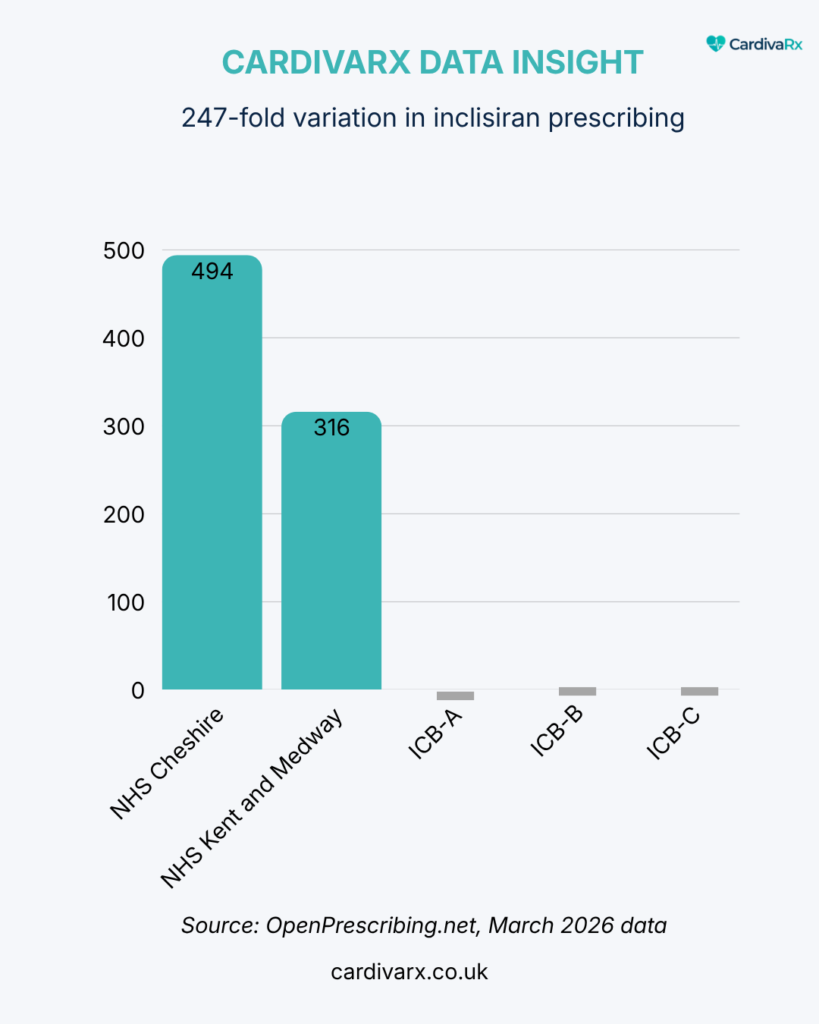
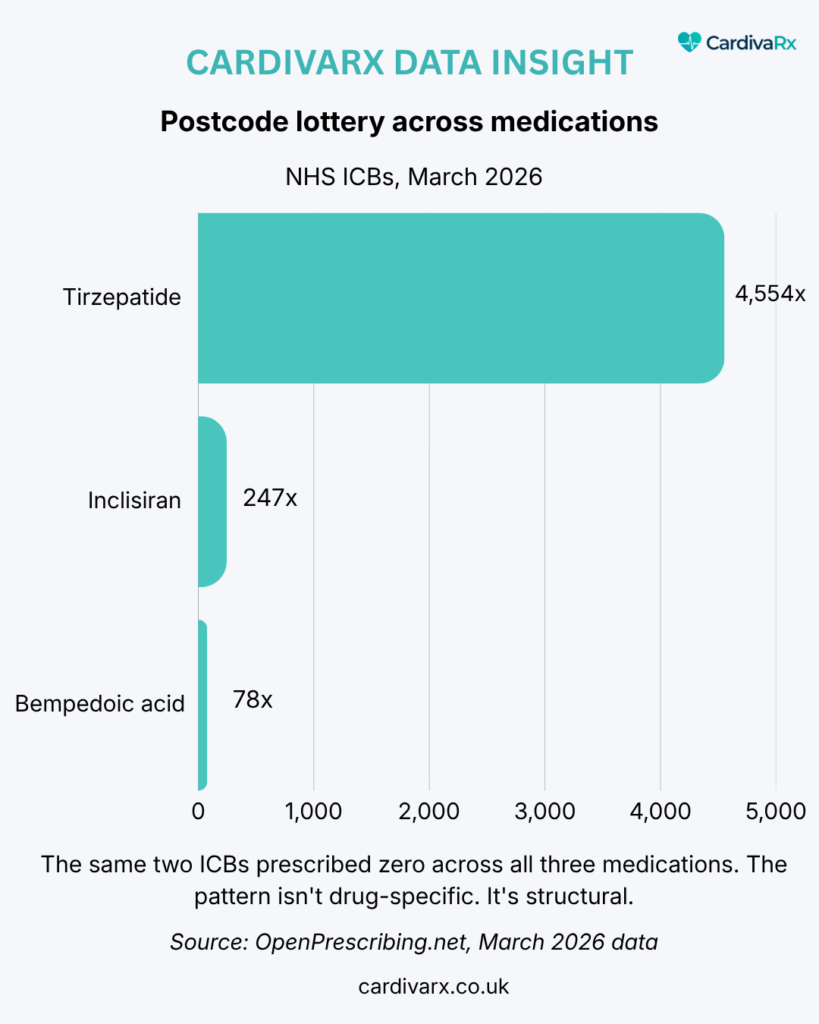
According to OpenPrescribing data for March 2026, the most recent month available, NHS Cheshire issued 494 inclisiran prescriptions, the highest in England; NHS Kent and Medway issued 316 prescriptions, the second-highest; and three English ICBs issued zero prescriptions, none at all. The variation between the highest and lowest prescribing ICBs is 247-fold.
This isn’t subtle local preference. It’s the difference between “this medication is part of routine cardiovascular care here” and “this medication doesn’t exist for our patients.”
To understand why, we need to look beyond the headline numbers because the formulary positioning tells a more complicated story than you might expect.
The Frimley Paradox: Permissive Formulary, Zero Prescriptions
One of the three ICBs that prescribed zero inclisiran in March 2026 actually has it on the most permissive possible formulary tier: GREEN, available for initiation and continuation in both primary and secondary care. No specialist referral required. No “amber” classification. No HCD restriction.
The most welcoming formulary status possible, and zero patients received the treatment.
This single finding breaks the intuitive assumption that “if a medication is on the formulary, patients can access it.” It demonstrates that formulary inclusion alone doesn’t predict patient access. Something else clinical leadership, implementation infrastructure, awareness among prescribers, or all three determines whether the door that the formulary opens actually gets walked through.
The Sub-ICB Paradox: Same Formulary, Opposite Outcomes
Even within a single ICB operating one formulary, outcomes can diverge dramatically. Within NHS Kent and Medway ICB, there are two sub-ICB locations. One of them shares the same formulary, clinical criteria, HCD classification, and specialist initiation requirement and issued zero inclisiran prescriptions in March 2026.
Same policy. Same medication. Same NICE recommendation. Same clinical eligibility. Completely opposite patient outcomes.
This tells us something important about UK healthcare access: patient experience depends on factors largely invisible to anyone trying to navigate the system. Local specialist capacity. Referral pathway efficiency. GP awareness. Patient identification systems. Historical prescribing patterns.
A patient checking their local formulary in either sub-ICB area would see identical positive status. Their actual access could not be more different.
What Cheshire Does Differently
To understand what drives high prescribing, the Cheshire and Merseyside formulary entry for inclisiran is instructive. It doesn’t just classify the medication; it provides three layers of operational support:
Clear clinical criteria: Secondary prevention only, with specific cardiovascular events listed (myocardial infarction, unstable angina requiring hospitalisation, coronary or arterial revascularisation, ischaemic stroke, peripheral arterial disease). LDL cholesterol must be persistently at or above 2.6 mmol/L despite maximally tolerated lipid-lowering therapy. The criteria are unambiguous; GPs can confidently identify eligible patients.
Operational infrastructure: The formulary specifies the wholesaler (AAH), the financial arrangement (nominal charge, 30-day payment), the account setup process for GP practices, and the reimbursement pathway (either the FP34D form or an FP10 prescription). Practical detail that turns “approved” into “actually prescribable.”
Honest scope: Primary prevention in the absence of established CVD is explicitly excluded: “Do Not Prescribe due to cost-effectiveness.” Clinicians know not just when to use inclisiran, but when not to.
The combination of clear criteria, operational detail, and honest scope appears to be what distinguishes Cheshire’s 494 prescriptions from the zero prescriptions seen elsewhere.
Formulary inclusion matters. But formulary detail, operational support, and clinical leadership matter at least as much.
Sources: NICE Technology Appraisal TA733; ORION-10 and ORION-11 clinical trials (National Institutes of Health); OpenPrescribing.net (March 2026 data); NHS Cheshire and Merseyside Joint Formulary; NHS Kent and Medway Joint Formulary.
Cholesterol, Bempedoic Acid: Same Pattern, Different Drug
If inclisiran were an isolated case, the variation finding might reflect medication-specific challenges, an unfamiliar mechanism, injectable delivery, or a novel pricing structure. But the pattern holds across modern cholesterol treatments.
NICE published Technology Appraisal TA694 in April 2021, recommending bempedoic acid (Nilemdo and the combination product Nustendi with ezetimibe) for treating primary hypercholesterolaemia or mixed dyslipidaemia in adults who can’t tolerate statins.
Bempedoic acid works upstream of statins in the cholesterol synthesis pathway. It inhibits ATP-citrate lyase, reducing cholesterol production in the liver, but unlike statins, it doesn’t activate in muscle tissue, which is why statin-intolerant patients (those who experience muscle-related side effects) can often tolerate it. According to Heart UK, bempedoic acid taken alone reduces LDL cholesterol by 17-28% after 12 weeks. Combined with ezetimibe (as Nustendi), reductions of up to 38% are achievable.
For patients who can’t tolerate maximum statin doses but still need LDL reduction beyond what ezetimibe alone provides, bempedoic acid fills a meaningful gap.
The Variation Continues
OpenPrescribing data for March 2026 shows:
– NHS Lincolnshire issued 1,804 bempedoic acid prescriptions, the highest in England, far ahead of any other ICB
– NHS Kent and Medway issued 820 prescriptions, the third highest
– Two English ICBs issued zero prescriptions
The variation between the highest and lowest is 78-fold less dramatic than inclisiran’s 247-fold variation, but still represents dramatically different patient access across England.
The Cross-Medication Pattern Emerges
Here’s where the analysis becomes more revealing. The two English ICBs that prescribed zero bempedoic acid in March 2026? They’re the same ICBs that prescribed zero inclisiran.
Two completely different medications. Different mechanisms. Different patient groups (inclisiran for established CVD with high LDL; bempedoic acid for statin-intolerant patients). Different delivery routes (injection vs oral). Different NICE Technology Appraisals. Different formulary considerations.
Same two ICBs absent from modern lipid prescribing. This consistency rules out medication-specific explanations. The issue isn’t “this particular drug is difficult.” It’s the structural patterns in clinical leadership, infrastructure, and implementation that broadly affect modern lipid management in these areas.
What Lincolnshire Does Differently
Just as Cheshire’s high inclisiran prescribing is explained by its detailed formulary, Lincolnshire’s bempedoic acid dominance has a clear explanation, though a different one.
In May 2023, the Lincolnshire Lipid Advisory Group published a comprehensive Lipid Management Pathway for Secondary Prevention in Cardiovascular Disease. The pathway is jointly authored by three organisations: Lincolnshire Community Health Services NHS Trust, NHS Lincolnshire ICB, and United Lincolnshire Hospitals NHS Trust. This multi-organisation authorship matters; it signals genuine institutional commitment to integrated lipid management across the local health economy.
The pathway integrates every modern lipid therapy: ezetimibe, bempedoic acid, inclisiran, PCSK9 inhibitors, and icosapentaerythritol. Each medication has clear positioning, specific LDL thresholds, and defined escalation criteria. Notably, the pathway applies the European Society of Cardiology’s risk-stratified LDL-C targets, which set tighter goals than NICE NG238, based on the patient’s cardiovascular risk category. Very high-risk patients (those with established atherosclerotic cardiovascular disease, diabetes with target organ damage, or familial hypercholesterolaemia with major risk factors) have an LDL-C target of less than 1.4 mmol/L. High-risk patients have a target of less than 1.8 mmol/L. These tighter targets encourage earlier intensification of treatment, including bempedoic acid, where statins alone are insufficient or not tolerated.
This isn’t just a formulary entry. It’s a complete clinical infrastructure: clear pathways, multi-organisation collaboration, evidence-based risk-stratified targets, and integrated treatment escalation. Patients with cardiovascular disease and elevated LDL in Lincolnshire benefit from this structured approach, which appears to explain why Lincolnshire prescribes more bempedoic acid than any other ICB in England.
The Two Patterns Together
By the end of Section 5a (inclisiran) and 5b (bempedoic acid), two patterns are becoming clear:
High prescribing requires more than formulary inclusion.
Cheshire’s detailed inclisiran formulary entry includes specific clinical criteria, operational infrastructure, and honest scope. Lincolnshire’s bempedoic acid prescribing benefits from a comprehensive, multi-organisation pathway document that includes risk-stratified targets and clear escalation criteria. In both cases, what drives access is the work surrounding the formulary, not just the formulary itself.
Low prescribing is consistent across medications
The same ICBs that prescribed zero inclisiran also prescribed zero bempedoic acid. This rules out medication-specific factors and points to structural challenges in the implementation of modern lipid management.
Sources: NICE Technology Appraisal TA694, Heart UK (clinical trial data: CLEAR Wisdom, CLEAR Tranquillity), OpenPrescribing.net (March 2026 data), Lincolnshire Lipid Advisory Group: Lipid Management Pathway for Secondary Prevention in Cardiovascular Disease (May 2023), NHS Lincolnshire ICB Joint Formulary
Diabetes And Weight Management, Tirzepatide: The Pattern Extends
The cross-medication pattern established in cholesterol prescribing isn’t confined to lipid therapies. It extends across cardio-metabolic care, and tirzepatide demonstrates this most dramatically.
Tirzepatide is a dual glucose-dependent insulinotropic polypeptide (GIP) and glucagon-like peptide-1 (GLP-1) receptor agonist. It’s administered as a once-weekly subcutaneous injection. The dual mechanism has produced striking clinical trial outcomes.
For type 2 diabetes (SURPASS programme), tirzepatide demonstrated HbA1c reductions of up to 2.07% as monotherapy, with superior glycaemic control and weight reduction compared to semaglutide, insulin degludec, insulin glargine, and placebo across the SURPASS-1 through SURPASS-5 trials.
For weight management (SURMOUNT programme), the results were more dramatic. SURMOUNT-1 demonstrated weight reductions of 16.5-22.4% over 72 weeks of treatment. SURMOUNT-4 showed a mean weight reduction of 25.3% in patients who continued treatment through 88 weeks, whereas those switched to placebo experienced significant weight regain.
For patients with type 2 diabetes who haven’t achieved targets on existing therapies, or patients with significant obesity needing pharmacological support alongside lifestyle changes, tirzepatide offers a substantial clinical option.
Two NICE Recommendations And A Funding Variation
For type 2 diabetes, NICE published TA924 in October 2023, recommending tirzepatide when triple therapy is required
For obesity management, NICE published TA1026 on 23 December 2024, recommending tirzepatide (Mounjaro) for adults with BMI ≥35 kg/m² plus weight-related comorbidities, with lower BMI thresholds (usually reduced by 2.5 kg/m²) for people from South Asian, Chinese, other Asian, Middle Eastern, Black African or African-Caribbean backgrounds.
But unlike most NICE Technology Appraisals, which legally require NHS funding within 90 days, NHS England formally submitted a funding variation request for tirzepatide. The request was granted: tirzepatide for obesity is being introduced in phases over a 3-year period, with prioritised patient cohorts accessing treatment first. Allocations are calculated based on obesity prevalence rates at ICB level.
This phased implementation is itself a recognition that immediate national rollout wasn’t operationally feasible. The medication is clinically and cost-effective; the constraint is system capacity to deliver it safely with appropriate wraparound services.
The Variation Reaches A Different Scale
OpenPrescribing data for March 2026 shows:
– NHS North East London issued 4,554 tirzepatide prescriptions, the highest in England
– NHS Devon issued 4,017 prescriptions, the second highest
– One English ICB issued zero prescriptions; another issued one, functionally zero
The variation between highest and lowest prescribing ICBs is 4,554-fold, substantially more dramatic than inclisiran’s 247-fold or bempedoic acid’s 78-fold variation.
Total national prescribing in March 2026 was 95,657 items, with NHS spending of £22.8 million in a single month.
This isn’t variation at the margins. This is one area that treats thousands of patients each month, while another treats none.
The Cross-Medication Pattern Now Spans Three Medications
Here’s what’s analytically striking. The English ICB that issued zero tirzepatide prescriptions in March 2026 is the same ICB that issued zero prescriptions for inclisiran and bempedoic acid. The ICB that issued just one tirzepatide prescription is the same area that issued zero of both cholesterol medications.
Three completely different medications. Three different mechanisms (siRNA, ATP-citrate lyase inhibitor, dual incretin agonist). Three different patient groups. Three different specialisms (cholesterol secondary prevention, statin alternative, diabetes/weight management). And different funding frameworks: a standard 90-day mandate for lipid medications, and a phased implementation under a funding variation for tirzepatide for obesity use.
Yet the same two ICBs are consistently absent from modern cardiometabolic prescribing.
The probability of this consistency arising from medication-specific factors is vanishingly small, particularly given the different funding frameworks. The pattern points to structural implementation gaps that affect modern cardiometabolic care in the following areas: clinical leadership, infrastructure, awareness, availability of specialist services, or some combination thereof.
Different Leaders For Different Medications
A second insight emerges when comparing the top prescribers across the three medications:
| Medication | Top prescriber |
|---|---|
| Inclisiran | NHS Cheshire (494 items) |
| Bempedoic Acid | NHS Lincolnshire (1,804 items) |
| Tirzepatide | NHS North East London (4,554 items) |
The “leader” varies dramatically by medication. NHS Cheshire dominates inclisiran with detailed formulary infrastructure but issues mid-pack tirzepatide. NHS Lincolnshire leads bempedoic acid with its Lipid Pathway document but ranks moderately for tirzepatide. London ICBs dominate tirzepatide despite not being top prescribers for either lipid medication.
This tells us something important: clinical leadership and pathway optimisation happen medication-by-medication, not ICB-by-ICB. An area can be excellent at one modern cardio-metabolic treatment and unremarkable at another. The Cheshire model that drives high inclisiran prescribing isn’t a transferable ICB-level capability; it’s specific to lipid management.
Why Different Areas Are Further Along
London ICBs occupy five of the top six positions for tirzepatide prescribing: NHS North East London, NHS South West London, NHS North West London, NHS North Central London, alongside NHS Bristol, North Somerset and South Gloucestershire and NHS Devon.
Within the funding variation framework, this distribution reflects several factors:
Obesity prevalence allocations
NHS England’s funding variation distributes allocations based on obesity rates at ICB level, legitimately concentrating resources where need is highest
Existing specialist services
Tier 3 weight management services and obesity specialist clinics are most established in metropolitan areas
Patient identification and pathway readiness
Areas with existing weight management infrastructure could onboard priority cohort patients fastest
Wraparound service capacity
NHS England guidance requires appropriate dietary, behavioural, and monitoring support alongside prescribing
This is not the same variation story as inclisiran or bempedoic acid. There, the variation reflects ICB-level commissioning decisions within a standard funding mandate. With tirzepatide, the variation is partially driven by the funding variation, but the patient experience remains the same: where you live determines when or whether you access treatment.
The Category C Connection
Section 3 noted that tirzepatide is listed in Category C of the Drug Tariff, with single-supplier pricing and no generic competition. This isn’t incidental to the story of variation.
Category C dynamics mean tirzepatide pricing is determined entirely by Eli Lilly. There’s no generic alternative to drive prices down. Supply is controlled by a single manufacturer’s production capacity and prioritisation decisions. When the 2024-2025 GLP-1 shortages hit globally, there was no alternative source within the UK supply chain.
For ICBs evaluating whether to actively encourage prescribing tirzepatide, the Category C cost profile warrants particular caution. A medication with no price competition, vulnerable to manufacturer supply decisions, and substantial per-patient annual costs poses commissioning challenges that established generic cardio-metabolic medications don’t face.
This is part of why some ICBs are slower to develop tirzepatide pathways; the financial and supply risks are real, and ICB commissioning committees make legitimate decisions about how quickly to expand access. But it doesn’t change the patient reality: people meeting NICE criteria in some areas wait indefinitely while those in others access treatment routinely.
Adoption Curve Is Widening The Gap
Tirzepatide prescribing has grown explosively since NICE approval. National prescribing rose from approximately 5 items in January 2024 to 95,657 items by March 2026. The medication is being adopted at an unprecedented pace across England
But while national prescribing has multiplied by orders of magnitude, the variation has worsened rather than improved. The 4,554-fold variation between top and bottom ICBs in March 2026 represents a widening gap, not a closing one. Leading ICBs are scaling up tirzepatide prescribing rapidly while non-adopting ICBs remain at or near zero.
This pattern matters for patients. “Wait and see” isn’t a neutral position when national prescribing is doubling year on year. Patients in non-adopting ICBs are falling further behind their peers adopting ICBs, and there’s no evidence the gap will close without active intervention.
Sources: NICE Technology Appraisals TA924 and TA1026, NEJM (SURPASS-1 through SURPASS-5, SURMOUNT-1, SURMOUNT-4), NHS England Interim Commissioning Guidance, OpenPrescribing.net (March 2026 data), NHS Business Services Authority Drug Tariff (Category C classifications)
Hypertension, Aprocitentan: When A Licensed Medication Awaits NICE Assessment
The fourth medication in our analysis reveals a different kind of access barrier. While inclisiran, bempedoic acid, and tirzepatide show substantial differences in how widely ICBs prescribe modern NICE-recommended treatments, aprocitentan reveals something more fundamental: what happens when a medication is licensed in the UK but hasn’t yet received a NICE Technology Appraisal.
Aprocitentan (Jeraygo) received UK marketing authorisation from the MHRA in January 2025 for treating resistant hypertension in adults defined as blood pressure remaining uncontrolled despite at least three antihypertensive medications including a diuretic.
Aprocitentan works through a novel mechanism. It’s a dual endothelin receptor antagonist that blocks the endothelin-1 pathway, which contributes to vascular constriction, sodium retention, and resistant hypertension. This makes it the first systemic antihypertensive in a new therapeutic class in nearly 40 years.
In the Phase 3 PRECISION trial, aprocitentan added to existing antihypertensive therapy produced clinically meaningful blood pressure reductions in patients whose hypertension hadn’t responded to conventional treatments. For the estimated 10-15% of UK hypertensive patients with resistant hypertension, perhaps 1.5-2.2 million people, this represents a genuinely novel treatment option where conventional drugs have failed.
But 18 months after UK marketing authorisation, aprocitentan is essentially invisible in primary care.
The Fundamental Access Barrier: No NICE Recommendation Yet
Unlike inclisiran, bempedoic acid, and tirzepatide, all of which have NICE Technology Appraisals establishing NHS funding mandates, aprocitentan does not yet have a NICE recommendation. NICE’s technology appraisal for aprocitentan (project TSID10395) is listed as “awaiting development.
This distinction matters enormously for patient access. NICE Technology Appraisals, when positive, legally require NHS funding within 90 days of publication. Without a NICE recommendation:
– There is no NHS funding mandate
– ICBs have no requirement to fund the medication
– Formulary committees have no NICE guidance to reference
– Primary care GPs have no formal pathway to prescribe
For patients, this creates a distinct access dynamic, one different from the ICB-level variation observed among the three NICE-recommended medications examined above.
Three Different States Of Non-Access
Examining publicly available ICB formulary documents shows how different areas are handling aprocitentan in the absence of a NICE recommendation:
State 1: Explicit non-formulary positions
One English ICB’s formulary documents include aprocitentan with the explicit status “Non-formulary (new product not yet discussed).” This is a transparent acknowledgement: the medicines committee knows the treatment exists, hasn’t formally reviewed it yet, and is honest about the current status.
State 2: Silent absence
Another English ICB’s formulary documents make no mention of aprocitentan whatsoever. There’s no “non-formulary” position, no pending review noted, no acknowledgement of the treatment’s existence in published formulary materials.
State 3: Hospital specialist clinic access only
Where aprocitentan does reach UK patients, it appears to be almost entirely through hospital hypertension specialist clinics. Referral required. Specialist initiation. Often without any established shared care pathway to primary care.
These three states are not equivalent for patients. Explicit non-formulary status creates clarity (and a potential pathway for formal review request once NICE guidance emerges). Silent absence creates uncertainty. Hospital specialist clinic access depends on referral capacity, which varies dramatically across England.
The Patient Experience Of Regulatory Lag
For patients with resistant hypertension, access to aprocitentan depends not on whether they meet clinical criteria for the medication, but on:
– Whether their GP recognises resistant hypertension as warranting specialist evaluation
– Whether their local area has an active hypertension specialist clinic
– How long the referral waiting list is – Whether the specialist clinic prescribes aprocitentan despite the absence of formal NICE recommendation
– Whether shared care arrangements exist between hospital and primary care
These factors vary enormously across England. The 18-month gap between UK marketing authorisation and an NHS funding recommendation isn’t unusual for novel medications; the standard NICE assessment process takes 12-24 months from the time of referral. But it represents real clinical impact for patients whose blood pressure continues to harm their cardiovascular system while the regulatory system catches up.
Resistant hypertension carries documented cardiovascular risks: increased stroke, myocardial infarction, heart failure, and chronic kidney disease compared to controlled hypertension. Each year of delayed access to effective treatment represents real risk accumulation.
What This Adds To The Pattern
The aprocitentan story doesn’t fit neatly with the variation findings from the other three medications, and that’s analytically useful. It represents a different access barrier operating at an earlier stage in the UK regulatory pathway.
For inclisiran and bempedoic acid, the variation concerns whether ICBs implement the standard 90-day NICE funding mandates with appropriate clinical pathways. For tirzepatide, the variation operates within an NHS England-sanctioned funding variation. For aprocitentan, the variation concerns whether the medication has transitioned from UK licensing to NICE recommendation at all and how ICBs handle a licensed medication during that regulatory interim period.
Different barriers. Different mechanisms. Same overall reality: patients with identical clinical need receive completely different levels of access depending on where they live, which medication they need, and what stage that medication has reached in the UK regulatory system.
Sources: MHRA UK marketing authorisation records, NICE project TSID10395 (aprocitentan awaiting development), Phase 3 PRECISION trial (published in New England Journal of Medicine), anonymised English ICB formulary documents, NHS Specialist Pharmacy Service
The Pattern: Same ICBs Absent Across Modern Cardio-Metabolic Care
By examining four different modern cardio-metabolic medications across three NICE-recommended treatment areas, a striking structural pattern emerges.
The same two English ICBs are prescribed at or near zero across three medications with completely different mechanisms, patient groups, and funding frameworks:
| Medication | Specialism | Mechanism | These two ICB’s |
|---|---|---|---|
| Inclisiran | Cholesterol, secondary prevention | SiRNA gene silencing | Zero,Zero |
| Bempedoic acid | Cholesterol, statin alternative | ATP-citrate lyase inhibitor | Zero, Zero |
| Tirzepatide | Diabetes / Weight management | Dual GIP/GLP-1 agonist | Zero, One |
Cross-medication prescribing pattern across three NICE-recommended cardio-metabolic medications, March 2026. Source: OpenPrescribing.net
This consistency rules out three intuitive explanations:
Not medication-specific:
Three different mechanisms, three different patient populations, three different specialisms. The issue isn’t “this particular drug is hard to access”; it’s broader.
Not funding-framework-specific
Two medications are subject to the standard 90-day NICE funding mandates. One operates under an NHS England-sanctioned funding variation with phased implementation. The same ICBs lag across both frameworks.
Not clinical-pathway-specific
Cholesterol management (lipid clinics, secondary prevention pathways), diabetes management (diabetes specialist services), and weight management (Tier 3 obesity services) are all clinically distinct domains. The same ICBs lag across all three.
What This Points To
When the same areas consistently appear at or near zero across multiple modern cardiometabolic medications, despite different mechanisms, patient groups, specialisms, and funding frameworks, the explanation isn’t found in any one medication’s specifics.
The pattern points to structural factors that affect modern cardio-metabolic care broadly within these specific ICBs:
Clinical leadership gaps
Absence of local champions driving modern treatment uptake across specialisms
Infrastructure limitations
Insufficient specialist service capacity (lipid clinics, diabetes services, weight management pathways) to support escalation beyond standard generic therapy
Patient identification systems
No active processes to flag eligible patients for modern treatments
Awareness and education
Limited GP and specialist familiarity with newer NICE-recommended options
Historical adoption patterns
Once an area lags behind early adopters, gaps tend to widen rather than close
These factors don’t appear in formulary documents. They’re not captured in NICE Technology Appraisal compliance metrics. They’re largely invisible to patients trying to understand their treatment options. Yet they appear to be the strongest predictors of whether modern cardio-metabolic treatments actually reach patients.
A Different Access Barrier: Aprocitentan
The fourth medication examined, aprocitentan for resistant hypertension, represents a related but distinct access barrier. Unlike the three cross-pattern medications, aprocitentan does not have a NICE Technology Appraisal at all. It received UK marketing authorisation from the MHRA in January 2025, but NICE’s assessment (TSID10395) remains under development. Without a NICE recommendation, there is no 90-day NHS funding mandate, and ICBs have no requirement to fund the medication.
This means the access barrier for aprocitentan operates at an earlier stage in the UK regulatory pathway, before the funding mandate that would drive ICB-level variation is established. For patients with resistant hypertension, the lag between UK licensing and NHS funding recommendation can be measured in years.
The Implication For Patients
For a patient with established cardiovascular disease and elevated cholesterol, or type 2 diabetes with weight management needs, or resistant hypertension, where you live in England and what stage your needed medication has reached in the UK regulatory system substantially shapes which modern treatments you’ll be offered, independent of your clinical eligibility.
This isn’t variation around the margins. For some patients, in some areas, modern cardio-metabolic treatment is essentially unavailable through routine NHS care. The same patient, with the same clinical profile, would receive different treatment recommendations in different parts of England.
Sources: OpenPrescribing.net (March 2026 data), NICE Technology Appraisals TA694, TA733, TA924, TA1026, NICE project TSID10395 (aprocitentan awaiting development).
What Drives Access: Lessons From High-Performing ICBs
The cross-medication pattern shows what’s missing in some ICBs. Looking at the high-prescribing ICBs reveals what’s present, and the common factors are instructive.
The Cheshire Model: Detailed Formulary Infrastructure
NHS Cheshire’s leadership in inclisiran prescribing (494 items in March 2026, the highest in England) is explained by its formulary.
The Cheshire and Merseyside Joint Formulary entry for inclisiran doesn’t just classify the medication. It provides three layers of operational support:
Clinical specificity
Defined patient eligibility (secondary prevention only, specific cardiovascular events listed, LDL ≥2.6 mmol/L threshold) so GPs can identify eligible patients confidently
Operational infrastructure
Named wholesaler (AAH), financial arrangements (nominal charge, 30-day payment), account setup process, reimbursement pathway (FP34D form or FP10 prescription)
Honest scope
Explicit “Do Not Prescribe” position for primary prevention without established CVD, supported by cost-effectiveness reasoning
This is formulary positioning that turns “approved” into “actually prescribable.” Clinicians know not just when to use inclisiran, but exactly how to use it, where to source it, and how to manage the reimbursement.
The Lincolnshire Model: Multi-Organisation Clinical Pathway
NHS Lincolnshire’s leadership in bempedoic acid prescribing (1,804 items in March 2026, far ahead of any other ICB) is explained by something different: a comprehensive clinical pathway document.
In May 2023, the Lincolnshire Lipid Advisory Group published a Lipid Management Pathway for Secondary Prevention in Cardiovascular Disease. The pathway is jointly authored by three organisations (Lincolnshire Community Health Services NHS Trust, NHS Lincolnshire ICB, and United Lincolnshire Hospitals NHS Trust), signalling institutional commitment to integrated lipid management.
The pathway integrates every modern lipid therapy with:
– Risk-stratified LDL-C targets (European Society of Cardiology 2019 targets, tighter than NICE NG238)
– Clear escalation criteria with specific LDL thresholds
– Defined positioning for each modern lipid therapy (ezetimibe, bempedoic acid, inclisiran, PCSK9 inhibitors, icosapent ethyl)
– Renal dosing considerations
– Statin intolerance pathway specifically defined
– Cross-organisation referral routes
This isn’t a formulary entry. It’s a complete clinical infrastructure, multi-organisation collaboration, evidence-based targets, and integrated treatment escalation.
What These Models Share
Different ICBs lead in different medications, but the high-prescribing ICBs share common characteristics:
Active clinical leadership
Someone a lipid consultant, a diabetes specialist, an ICB pharmacy lead, a multi-disciplinary group actively champions modern treatments locally. The Cheshire formulary detail and the Lincolnshire Advisory Group both reflect this human dimension.
Integration beyond the formulary
High-prescribing ICBs don’t just list medications. They build the surrounding infrastructure: referral pathways, operational arrangements, clinical criteria, multi-organisation collaboration that turns approval into access.
Patient identification systems
Areas with high prescribing have ways to identify eligible patients: disease registers, audit programmes, structured medication reviews. Without identification, even the best formulary entry produces minimal prescribing.
Multi-disciplinary collaboration
The pathways and infrastructure that support high prescribing involve collaboration across primary care, secondary care, pharmacy, commissioning, and patient advocacy. Both the Cheshire formulary entry and the Lincolnshire pathway document show multi-organisation input in their production.
What these high-performing ICBs demonstrate is that the variation isn’t about whether modern cardio-metabolic care is possible within NHS structures; it clearly is. The variation concerns whether the structures, leadership, and infrastructure to deliver it exist in a particular area.
Sources: NHS Cheshire and Merseyside Joint Formulary, Lincolnshire Lipid Advisory Group: Lipid Management Pathway for Secondary Prevention in Cardiovascular Disease (May 2023), OpenPrescribing.net (March 2026 data).
What This Actually Means For Patients
Behind every prescribing variation statistic is a patient with a specific clinical need, a specific eligibility for a NICE-recommended treatment, and a specific outcome shaped by where they live. The following scenarios illustrate how the patterns described above translate into concrete patient experience.
Scenario 1: Established Cardiovascular Disease
A patient in their early 60s had a myocardial infarction three years ago. They take atorvastatin 80mg daily — the maximum tolerated statin dose, but their LDL cholesterol remains at 3.1 mmol/L. They meet the NICE TA733 criteria for inclisiran: established cardiovascular disease and persistent LDL ≥2.6 mmol/L despite maximally tolerated lipid-lowering therapy.
In one ICB, the same patient would be referred to lipid specialist services, assessed against clinical criteria, and started on inclisiran within months of meeting the eligibility criteria. In another ICB, their GP would have no operational pathway for referral or initiation. The same clinical need, the same NICE eligibility, completely different cardiovascular risk trajectories over the following years.
Scenario 2: Type 2 Diabetes With Obesity
A patient in their late 40s has type 2 diabetes inadequately controlled despite triple oral therapy. Their HbA1c is 78 mmol/mol (target 53 mmol/mol). They have a BMI of 38 with obstructive sleep apnoea. They meet NICE TA1026 criteria for tirzepatide for obesity, and NICE TA924 criteria for tirzepatide for diabetes.
In a high-prescribing ICB with established weight management services and active tirzepatide pathways, this patient would be assessed, prioritised, and started on treatment within months. In a lower-prescribing ICB, particularly under the phased implementation arrangements, they might wait years for access or never access NHS treatment at all, despite meeting all clinical criteria.
Scenario 3: Resistant Hypertension
A patient in their mid-50s has resistant hypertension. They take amlodipine 10mg, ramipril 10mg, and indapamide 2.5 mg daily, three antihypertensives, including a diuretic, but their home blood pressure averages 158/96 mmHg. Their cardiovascular risk continues to accumulate.
Aprocitentan received UK marketing authorisation from the MHRA in January 2025, with documented efficacy in resistant hypertension demonstrated in the Phase 3 PRECISION trial. However, NICE has not yet completed its Technology Appraisal (TSID10395, currently awaiting development), meaning no NHS funding mandate exists. Access via the NHS depends entirely on whether their local hypertension specialist clinic prescribes aprocitentan despite the absence of a formal NICE recommendation. Some patients wait months for clinic appointments only to learn the medication isn’t available through the NHS in their area. Others receive no referral at all if their GP doesn’t recognise resistant hypertension as warranting specialist evaluation.
The Cumulative Impact
These aren’t isolated examples. A patient managing cardiometabolic conditions over 10-20 years makes dozens of treatment decisions: initial medication choices, escalation steps, response assessments, switches, dose adjustments, and additions of new classes as evidence evolves.
Each decision is shaped by what’s locally available, what local GPs are comfortable prescribing, what specialist services exist, and what the patient is offered. Over a decade, two patients with identical conditions starting from identical baselines could follow completely different treatment trajectories with materially different cardiovascular outcomes purely because of where they live.
That’s the substance behind the variation statistics. Not abstract policy differences, but accumulating clinical consequences for real patients managing serious chronic conditions.
Note: Scenarios are composite constructions illustrative of NICE eligibility criteria and prescribing variation patterns. No specific patients are represented
What Patients Can Actually Do
Understanding why prescribing variation exists is only useful if it translates into things patients can do. For people with cardiometabolic conditions navigating this system, four practical steps can meaningfully improve access to treatment.
Step 1: Know What You’re Eligible For
NICE Technology Appraisals are publicly available and free to read. The recommendations include specific eligibility criteria, your cardiovascular history, current medications, clinical thresholds, and treatment goals.
For cholesterol management with established cardiovascular disease, read NICE TA733 (inclisiran) and TA694 (bempedoic acid). For type 2 diabetes or weight management, read TA924 and TA1026 (tirzepatide). For resistant hypertension, the situation is different: aprocitentan is MHRA-licensed in the UK, but NICE assessment is ongoing, so NHS access depends on the availability of specialist clinics rather than a formal funding mandate.
Reading these documents isn’t a substitute for clinical advice. But understanding what you’re potentially eligible for transforms the conversation with your GP from “what’s available?” to “I believe I meet criteria for X, can we discuss this?”
Step 2: Understand Your Local Formulary
Most ICB formularies are publicly available online. Search “[your ICB name] formulary,” for example, “NHS South East London formulary” or “NHS Cheshire and Merseyside formulary.” The documents may be lengthy and in PDF format, but they’re searchable.
Look up specific medications by name to see your local position:
– GREEN tier = available for primary care initiation
– AMBER tier = specialist initiation or shared care required
– RED tier = hospital prescribing only
– Non-formulary = not recommended or not yet reviewed
If a medication isn’t on your local formulary, that itself is useful information. It means either your ICB has actively decided against funding it, or the formulary committee hasn’t yet reviewed it. Both situations have implications for what to ask next.
Step 3: Ask The Right Questions
When discussing treatment options with your GP, sophisticated questions get more sophisticated answers. Consider asking:
– “What formulary tier is [medication] on in our local area?”
– “If it’s amber or red, what would the referral pathway involve?”
– “Is there a clinically equivalent alternative on the formulary that I could try first?”
– “What’s the threshold I’d need to meet to be eligible for specialist referral?”
For specialist appointments (cardiology, diabetes, lipid clinics, hypertension clinics), specific questions matter even more:
– “Given my clinical profile, what’s the optimal escalation pathway?”
– “What’s the LDL/HbA1c/BP target you’d aim for in my case?”
– “If we don’t reach target with current treatment, what’s the next step in your view?”
Step 4: Know Your Alternative Routes
NHS care is the default and usually appropriate first choice. But when local formulary restrictions, waiting lists, or specialist service gaps create barriers, alternative routes exist:
- Clinical trial enrolment: Research participation can provide access to newer treatments not yet routinely available
- Private specialist consultation: A one-off private cardiology, diabetes, or lipid clinic appointment may provide specialist assessment and recommendations you can take back to your GP for shared care
- Private prescribing through specialist services: For medications consistently unavailable through your local NHS pathways, private prescription with NHS continuation (where feasible) provides another option
These alternatives aren’t necessary for most patients. For patients whose NHS treatment journey has stalled despite clear clinical need, knowing they exist matters.
Patient navigation note: Always discuss treatment decisions with your GP and relevant specialists. This article describes systemic patterns; your individual clinical situation requires individual clinical assessment.
How Private Cardio-Metabolic Care Can Help
For most patients, most of the time, NHS care provides appropriate management of cardio-metabolic conditions. Millions of people across England receive excellent hypertension, diabetes, and lipid management through their GP surgeries every day.
But the analysis above demonstrates that “appropriate management” looks different depending on where you live. For patients in areas where modern NICE-recommended treatments are functionally inaccessible or where waiting lists for specialist clinics mean months or years of delayed escalation, private specialist care can address specific gaps the current system creates.
What Private Cardio-Metabolic Care Can Address
Specialist consultation without referral delays: Private cardiology, diabetes, and lipid clinic appointments typically have waiting times of days to weeks rather than months. For patients whose NHS referral has been delayed, or whose GP hasn’t identified them as requiring specialist input, private consultation provides direct access.
Prescribing options unavailable locally: Where a NICE-recommended medication is available but not accessible through your local NHS pathway, private prescribing allows access based on clinical eligibility rather than local commissioning decisions. This particularly matters for cardio-metabolic patients meeting NICE criteria in ICBs with limited modern treatment infrastructure.
Continuity across the treatment journey: NHS pathways can create fragmentation: referral to a specialist, wait for an appointment, wait for follow-up, back to the GP, potentially back to the specialist for escalation. Private services can maintain continuity with the same prescribing clinician across initial assessment, treatment initiation, monitoring, and escalation.
Time and attention for complex management: Standard 10-minute GP appointments and 20-minute specialist consultations aren’t always sufficient for patients managing multiple cardio-metabolic conditions with several medication interactions. Private consultations typically allow 30-45 minutes for initial assessment and 20-30 minutes for follow-ups.
When Private Care Isn’t The Right Answer
Private cardio-metabolic care makes sense for specific situations, not universally. It’s not the right answer when:
– Your NHS treatment is working well, and you’re reaching clinical targets
– The medication you need is available through your local formulary
– Cost is a genuine barrier; NHS remains the appropriate route for most patients regardless of local variation – Your condition is unstable or acute; NHS urgent care pathways are appropriate
– You require complex multi-speciality coordination that’s better managed within integrated NHS services
Private care is a tool for specific access gaps, not a replacement for NHS care.
Choosing Private Cardio-Metabolic Care
If private specialist care becomes an appropriate option, choosing the right service matters:
Look for clinical specialism: General private GP services handle broad primary care needs. Cardio-metabolic-specific services offer deeper expertise in hypertension, diabetes, and lipid management, specifically including familiarity with the modern NICE-recommended treatments discussed throughout this article.
Verify regulatory status: UK private prescribing must be delivered by clinicians registered with the appropriate professional bodies (the General Medical Council for doctors, the General Pharmaceutical Council for pharmacist prescribers), and services must be registered with the Care Quality Commission where applicable.
Understand the cost structure: Private specialist consultations typically cost £150- £ 400, depending on the specialism and location. Prescription costs are separate and depend on the medication; private prices for cardio-metabolic medications can differ substantially from NHS prescription charges.
Consider integration with NHS care: The best private services share detailed consultation notes with your GP, support NHS continuation prescribing where possible, and don’t create parallel treatment records that fragment your care.
This article was written by Daniel Obahor, a GPhC-registered pharmacist and founder of CardivaRx Ltd. CardivaRx is in the pre-launch phase and will become available as a private cardiometabolic prescribing service in late 2027, following completion of the Independent Prescriber qualification at the University of Portsmouth. The service is being built specifically to address the structural access gaps described in this article. Patients interested in registering early interest can contact via cardivarx.co.uk.
Frequently Asked Questions
Why do different areas of England prescribe different medications?
England’s NHS delivers healthcare through 42 Integrated Care Boards (ICBs), each responsible for local commissioning decisions. When NICE recommends a medication, ICBs typically have 90 days to fund it, but implementation depends on local formulary committees, clinical pathways, specialist service capacity, and prescribing infrastructure. These local factors create genuine variation in which medications actually reach patients, even when national NICE recommendations are identical.
Is prescribing variation the same as a “postcode lottery”?
The phrase “postcode lottery” captures the reality that where you live affects your access to treatment, but the underlying causes are more structural than the term suggests. ICB variation reflects specific factors: local formulary decisions, specialist service availability, clinical leadership, patient identification systems, and infrastructure to translate NICE recommendations into routine prescribing. Understanding these factors is more useful than framing variation as random.
How do I find out which medications my local ICB prescribes?
OpenPrescribing.net is a public tool that shows NHS prescribing data by ICB and GP practice. You can search for specific medications and see how your local area compares to national averages. For formulary positions specifically, search “[your ICB name] formulary”; most ICBs publish these documents online, though they may require some navigation to find specific medications.
If a medication is on my local formulary, does that mean I can access it?
Not necessarily. Formulary inclusion is a necessary but not sufficient condition for access. Even medications on the most permissive formulary tier (GREEN — available for primary care initiation) may not reach patients if local clinical pathways, patient identification systems, or specialist support infrastructure are insufficient. This article documents examples of ICBs with permissive formulary positions but zero prescribing of specific NICE-recommended treatments.
Can I request a specific medication from my GP?
You can discuss specific medications with your GP. Whether they can prescribe depends on your local formulary tier (GREEN allows primary care initiation; AMBER requires specialist initiation or shared care; RED is hospital-only), your clinical eligibility against NICE criteria, and your GP’s clinical judgement. Coming to appointments with specific NICE Technology Appraisal references (e.g., “I meet TA733 criteria for inclisiran”) transforms the conversation into a specific clinical discussion.
Why isn’t aprocitentan widely available if it’s UK-licensed?
Aprocitentan received MHRA UK marketing authorisation in January 2025 for resistant hypertension. However, UK licensing and NHS funding are separate processes. NICE Technology Appraisal TSID10395 for aprocitentan is currently listed as “awaiting development”, meaning no formal NHS funding mandate exists yet. The typical NICE assessment process takes 12-24 months from the time of referral. Until a positive NICE recommendation is issued, ICBs have no requirement to fund aprocitentan through routine NHS prescribing.
Should I consider private care for cardio-metabolic conditions?
Private care makes sense in specific situations: when NHS treatment pathways have stalled despite clear clinical need, when your local formulary doesn’t include a medication for which you meet NICE criteria, or when specialist waiting times are creating clinically meaningful delays. For patients whose NHS treatment is working well, or when cost is a genuine barrier, NHS care remains the appropriate choice. Private specialist consultations typically cost £150-400 in the UK.
What’s the difference between a formulary and the Drug Tariff?
Formularies are local ICB documents specifying which medications your area’s NHS commissioners will fund and under what conditions. The Drug Tariff is a national document (published monthly by the NHS Business Services Authority) specifying how much pharmacies are reimbursed for each medication they dispense on NHS prescriptions. Formularies affect which medications you can access; the Drug Tariff affects pricing dynamics, supply, and practical dispensing logistics.
What data sources support this article?
This article draws on publicly available data and documents: NICE Technology Appraisals (TA694, TA733, TA924, TA1026, and project TSID10395); NHS Business Services Authority Drug Tariff documentation; OpenPrescribing.net (March 2026 prescribing data); MHRA marketing authorisation records; anonymised and named English ICB formulary documents; and clinical trial publications (ORION-10 and ORION-11 for inclisiran; CLEAR Wisdom and CLEAR Tranquility for bempedoic acid; SURPASS-1 through SURPASS-5 and SURMOUNT-1 and SURMOUNT-4 for tirzepatide; PRECISION for aprocitentan).